Tuesday, April 29, 2014

Friday, April 25, 2014
Surfaces of Motion
From the contours of motion studied, I generated surfaces of individual limbs, then compiled them to create a three dimensional component to the 2D drawing.
 |
| Individual surfaces |
 |
| perspective view of overlapped surfaces |
 |
| Front view wireframe |
Sunday, April 13, 2014
Virtual Projection
Re-presenting motion of the human body
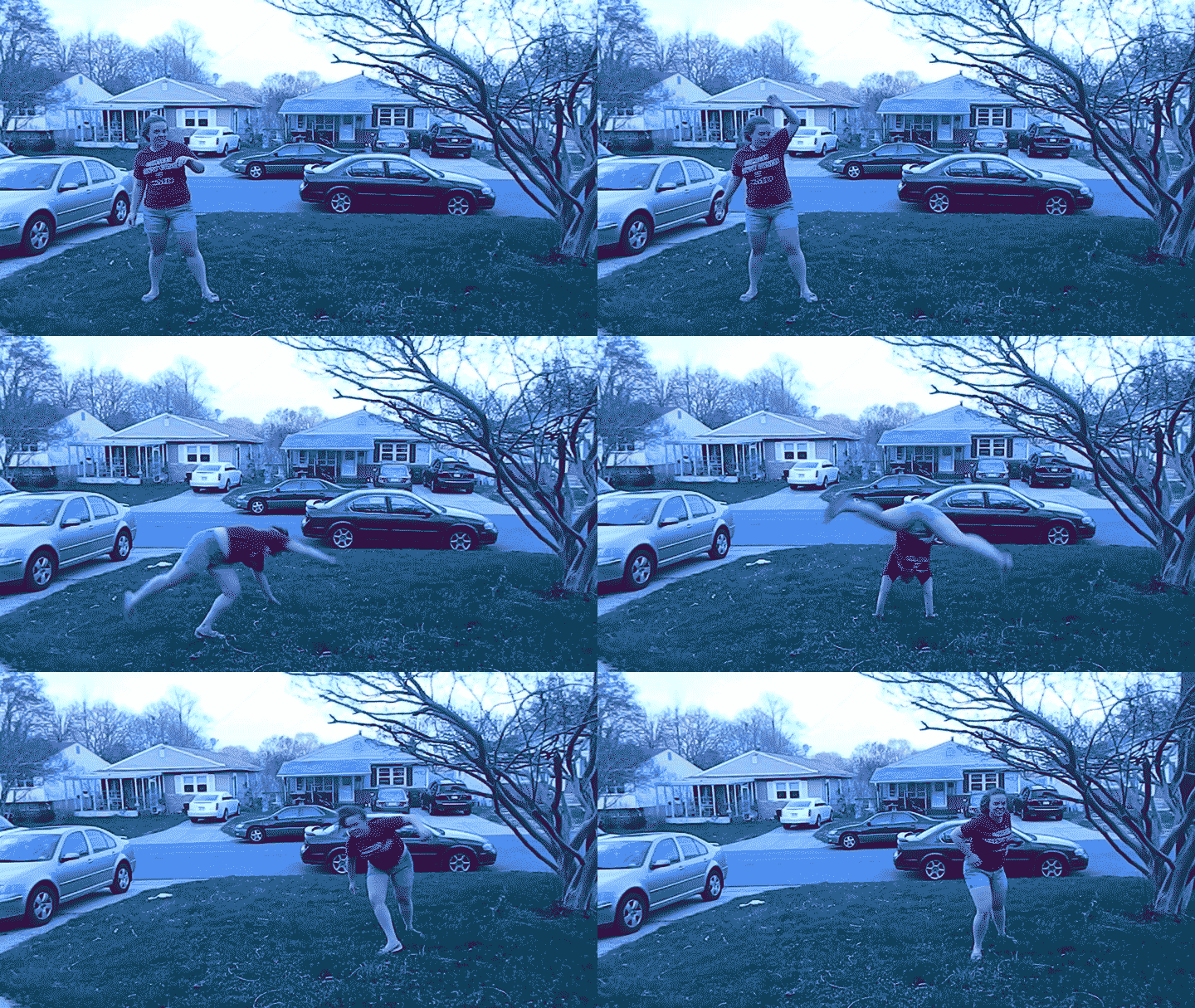 |
| motion of study: the cartwheel |
 |
| composition of frames of video |
 |
| motion of right arm |
 |
| motion of left arm |
 |
| motion of right leg |
 |
| motion of left leg |
Beginning to examine contours of motion without context of human body:

 |
Tuesday, March 4, 2014
Versioning
response to Versioning: Evolutionary Techniques in Architecture
SHoP begins their introduction by providing a definition for versioning as "an operative term to describe recent, significant shift in the way architects and designers are using technology to expand... the potential effects of design on our world." I appreciated their introduction as it cut to the chase and provided a robust overview of this idea of 'versioning'. Before this reading, I was not exposed to this ideology that has formed from current technological advancements, or as SHop put it, "an attitude not ideology."
The idea of testing and adapting sets of conditions is similar to Angelil's view of education as research oriented-- designed by probing questions and challenging norms. SHoP views this approach as a "process product" where the focus is on the fabrication process rather than a final image, also similar to Angelil's critique of architecture's focus on object. "Here the form, the forces that shape it, and the assemblage of materials in which we execute the ideology are part of the same gesture."
"Precision becomes the operative technique for manipulating the membrane that materialises or represents the contents of the spaces of buildings." This idea was illustrated through Kahn's Exeter Library and Eladio Dieste's Church of Christ the Worker. Kahn uses the unit of a brick as patterning, but it becomes a system independent of the structural system, whereas Dieste combines surface and space into a singular entity, yet the geometry of the tectonic units is sacrificed. Geometry and patterning are in opposition in both of these works. Office dA attempts to address these simultaneously, such as the example they give of their Hookah bar at Mantra. Plywood 'bricks' are employed as the unit of structure. This might simplify the relationship between geometry and tectonics, but it complicates its reading. The beauty I see in Dieste's Church is the advanced geometry used to create a skin simplistic in materiality yet rich in character and experience.

SHoP
SHoP begins their introduction by providing a definition for versioning as "an operative term to describe recent, significant shift in the way architects and designers are using technology to expand... the potential effects of design on our world." I appreciated their introduction as it cut to the chase and provided a robust overview of this idea of 'versioning'. Before this reading, I was not exposed to this ideology that has formed from current technological advancements, or as SHop put it, "an attitude not ideology."
The idea of testing and adapting sets of conditions is similar to Angelil's view of education as research oriented-- designed by probing questions and challenging norms. SHoP views this approach as a "process product" where the focus is on the fabrication process rather than a final image, also similar to Angelil's critique of architecture's focus on object. "Here the form, the forces that shape it, and the assemblage of materials in which we execute the ideology are part of the same gesture."
 |
| SHoP's Dunescape at MoMA PS1 |
Office dA
Monica Ponce de Leon and Nader Tehrani
Representing their approach to versioning as a reciprocal and codependent relationship between surface and space allows the exploration of the relationship between geometry and tectonic systems. Their goal is to have the skin and interior space(s) of buildings to read as one, rather than two separate systems. For most of architectural history, these two can be seen as separate systems, as discussed, such as load-bearing Renaissance construction in which the facade is read as an applique pasted onto a heavy building mass."Precision becomes the operative technique for manipulating the membrane that materialises or represents the contents of the spaces of buildings." This idea was illustrated through Kahn's Exeter Library and Eladio Dieste's Church of Christ the Worker. Kahn uses the unit of a brick as patterning, but it becomes a system independent of the structural system, whereas Dieste combines surface and space into a singular entity, yet the geometry of the tectonic units is sacrificed. Geometry and patterning are in opposition in both of these works. Office dA attempts to address these simultaneously, such as the example they give of their Hookah bar at Mantra. Plywood 'bricks' are employed as the unit of structure. This might simplify the relationship between geometry and tectonics, but it complicates its reading. The beauty I see in Dieste's Church is the advanced geometry used to create a skin simplistic in materiality yet rich in character and experience.
Monday, March 3, 2014
Compositional Surfaces
For 1c, I examined the matrix that I have been working on and was interested in the surface that looked like frayed ribbon, with curling edges.

I selected the last three surfaces from the series of morphologies of the original object to further study the geometries of surfaces. From these three surfaces, I chose the end segment (in red) to isolate.

![]()


I selected the last three surfaces from the series of morphologies of the original object to further study the geometries of surfaces. From these three surfaces, I chose the end segment (in red) to isolate.
I then isolated the pieces from their parent surfaces, rotating them and seeing how they morphed from one to the next.
When I turned on the control points for the surfaces, I was surprised to find the control points for the entire original surface embedded in the segments.
Below are the surfaces I am 3D printing. I want to see, physically, how the added complexity in control points affects the surface as it morphs.
 |
| Physical manifestation of surfaces |
Externalization and Experimentation
response to Inchoate: An Experiment in Architectural Education by Marc Angelil
I found Inchoate to be a read that is very relevant to the questions being asked by architectural education today. I was really drawn to the comparison of education and the Apollonian- Dioysian dichotomy, studied by Friedrich Nietzsche. Both teaching and learning can be seen as a split between promoting and questioning an area of study.
This brings to mind the lateralization of brain functions, generalized to left brain and right brain, that have been represented visually, as seen below.

The biggest obstacle I see in this triad is the focus on authorship, and more specifically the 'starchitect' concept. These days, architecture needs to move in the direction of cross-disciplinary collaboration. Its importance has been recognized, especially when discussing sustainable building practices. With so many fields of such narrow specialization it is increasingly important for these fields to work together. Another successful example of externalization is IDEO and their aprroach to Human Centered Design that relies on an interdisciplinary group of people working towards empathetic design solutions. Part of externalizing is questioning the role of architecture and architect. What is the role of architecture? The notion of 'architect as artist'? Are buildings to be seen as objects in the landscape? Ways of negotiating space?
I found Inchoate to be a read that is very relevant to the questions being asked by architectural education today. I was really drawn to the comparison of education and the Apollonian- Dioysian dichotomy, studied by Friedrich Nietzsche. Both teaching and learning can be seen as a split between promoting and questioning an area of study.
"With the Apollonian propensity for harmonious entities a sort of positivity is exerted, in terms of asserting a body of ideas, of understanding commonly agreed upon ways of thinking... At the other extreme, the Dionysian tendency to shatter established codes acquires a type of negativity probing into aspects that seem to defy logical underpinnings, scrutinizing foundations, transgressing boundaries."
This brings to mind the lateralization of brain functions, generalized to left brain and right brain, that have been represented visually, as seen below.
Externalization
Angelil identifies the internalization of the field of architecture as an impediment to the progress of the field through the focus on: visual appearances, authorship, and the object.The biggest obstacle I see in this triad is the focus on authorship, and more specifically the 'starchitect' concept. These days, architecture needs to move in the direction of cross-disciplinary collaboration. Its importance has been recognized, especially when discussing sustainable building practices. With so many fields of such narrow specialization it is increasingly important for these fields to work together. Another successful example of externalization is IDEO and their aprroach to Human Centered Design that relies on an interdisciplinary group of people working towards empathetic design solutions. Part of externalizing is questioning the role of architecture and architect. What is the role of architecture? The notion of 'architect as artist'? Are buildings to be seen as objects in the landscape? Ways of negotiating space?
 |
| Frank Gehry |
vs.
 |
| IDEO's Human Centered Design |
Experimentation
Questioning the role of architecture is precisely what Angelil sees as the basis of architectural education. Teaching and learning can be seen as a type of inquiry: research that proposes, tests, and reevaluates hypotheses. They "constitute acts of transgression, interrogating from both within and without...emerging unexpectedly into new positions". This goes back to the Apollonian- Dioysian dichotomy in which you must both gain knowledge and then question the foundation that knowledge is built on. By questioning both knowns and unknowns within and beyond the field of architecture, the field can expand beyond traditional boundaries and propose new solutions.
Tuesday, February 25, 2014
Time, Culture, and Loops
response to Contemporary Techniques in Architecture by Ali Rahim
If there is one outstanding observation from this piece it is the emphasis on the culture and time. Some key phrases in their relationship with technology were:
Cultural proliferation, production, and transformation
Temporal processes, organizations, and cycles
Rahim outlines his perception of contemporary techniques: their processes and effects. He argues that technology is essentially a development of cultural progression. It is a feedback loop of constant evolution that cannot be defined by a single moment, but rather as a "qualitative set of relations that interact with cultural stimuli". To see technology through a lens of reactions to cultural interactions, he sees the computer as an object that can only be understood in its context, as a technological object that exists temporally. It is part of a "continuous temporal organizational process of cultural proliferation."
Creation lies in the possibility of what does not yet exist and these possibilities can be discovered through the use of technology. I really like this idea that Rahim brings up. The power of technology doesn't exist in its speed of completing otherwise lengthy operations, or its crisp appearance, but instead, it is able to do so much of what architects used to do by hand that now we can take full advantage of discovering the possibilities that can be accomplished with this extremely powerful tool.
While I understand many of the points Rahim repeats throughout this reading, my one critique is that his entire passage is focused on (and entitled) "Contemporary Techniques" yet not once does he stop to give any attempt at defining/ specifying these somewhat ambiguous terms. I received some answers towards the end of the piece, with the example of Variations (a residence in Islamabad) in which he uses inverse kinematics to asses temporally changing programmatic elements and opportunities. This multi-faceted use of water he discusses, and the way it can serve as both a swimming pool and a retention pool is a unique opportunity that is available with contemporary technology.
I am most interested in the discussion of materiality and technology's opportunity for digital fabrication. Properties of materials such as density and porosity can move from stagnation to more dynamic effects.
The flexibility and freedom that contemporary technology gives us can enable us to find solutions that are more responsive to the ever-challenging demands of our time.
If there is one outstanding observation from this piece it is the emphasis on the culture and time. Some key phrases in their relationship with technology were:
Cultural proliferation, production, and transformation
Temporal processes, organizations, and cycles
Rahim outlines his perception of contemporary techniques: their processes and effects. He argues that technology is essentially a development of cultural progression. It is a feedback loop of constant evolution that cannot be defined by a single moment, but rather as a "qualitative set of relations that interact with cultural stimuli". To see technology through a lens of reactions to cultural interactions, he sees the computer as an object that can only be understood in its context, as a technological object that exists temporally. It is part of a "continuous temporal organizational process of cultural proliferation."
Creation lies in the possibility of what does not yet exist and these possibilities can be discovered through the use of technology. I really like this idea that Rahim brings up. The power of technology doesn't exist in its speed of completing otherwise lengthy operations, or its crisp appearance, but instead, it is able to do so much of what architects used to do by hand that now we can take full advantage of discovering the possibilities that can be accomplished with this extremely powerful tool.
While I understand many of the points Rahim repeats throughout this reading, my one critique is that his entire passage is focused on (and entitled) "Contemporary Techniques" yet not once does he stop to give any attempt at defining/ specifying these somewhat ambiguous terms. I received some answers towards the end of the piece, with the example of Variations (a residence in Islamabad) in which he uses inverse kinematics to asses temporally changing programmatic elements and opportunities. This multi-faceted use of water he discusses, and the way it can serve as both a swimming pool and a retention pool is a unique opportunity that is available with contemporary technology.
I am most interested in the discussion of materiality and technology's opportunity for digital fabrication. Properties of materials such as density and porosity can move from stagnation to more dynamic effects.
"The threshold of the line is moved to a gradient so that opaque, translucent and transparent effects can occur in one surface in continuous variation."
 |
| MoMA Installation- Contemporary Architecture Practice |
 |
| MSK Lobby Wall- LTL Architects |
Subscribe to:
Posts (Atom)